Scott Raisanen, HOA Roofing Consultant
Last Updated: July 2026
The Quick Answer
A roofing estimate should include more than a final price.
A useful estimate should explain what problem the contractor found, why the work is being recommended, what areas of the roof are included, what materials will be used, what is excluded, how hidden damage will be handled, what warranties apply, how the project will be completed, and how long the price is valid.
Most importantly, the estimate should connect the recommendation to the actual condition of your roof.
If a contractor says your roof needs a repair, replacement, tile underlayment replacement, foam recoat, or flashing correction, the proposal should help you understand why. Photos, video, inspection notes, and clear explanations can make a big difference.
If an estimate only says “roof repair” or “roof replacement” with a price, you do not have enough information to compare it fairly against another quote.
The goal is not to choose the cheapest estimate automatically. The goal is to understand what you are actually buying, what problem is being solved, and whether the proposed work makes sense for your roof.
Why Roofing Estimates Are Hard to Compare
Most homeowners do not replace a roof often. So when two or three roofing estimates come in, it is natural to look first at the final number.
But the final number does not tell the whole story.
One estimate may include a full roof system with upgraded underlayment, new flashing, proper cleanup, detailed photo documentation, and a stronger workmanship warranty. Another may reuse more existing components, include lower-grade materials, exclude certain repairs, or leave hidden damage as an unknown cost.
Both estimates may say “roof replacement,” but they may not be the same job.
This is where homeowners get frustrated. They assume they are comparing apples to apples, but they may actually be comparing very different scopes of work.
A detailed roofing estimate should make the difference easier to understand. It should help you see what the contractor found, what they recommend, and how that recommendation connects to your actual roof.
A Good Roofing Estimate Should Show You the Problem
A roofing estimate should not just tell you what the contractor recommends. It should show you why the work is being recommended.
This is one of the biggest differences between a vague estimate and a useful one.
If a contractor says a valley is leaking, the proposal should show the valley area. If the contractor says tile underlayment is failing, the proposal should show the condition of the underlayment where it was inspected. If the contractor says flashing is damaged, the proposal should show the flashing issue. If the contractor says a foam roof needs recoating, the proposal should explain what they saw on the coating surface.
Photos or video are not just sales tools. They help turn the contractor’s explanation into something the homeowner can see and understand.
That matters because roofing problems are often hidden. A ceiling stain may not show where water entered. A tile roof may look fine from the ground while the underlayment is failing underneath. A flat roof may have drainage or coating problems that are hard to see from the driveway.
A good roofing estimate should answer three basic questions:
What did the contractor find?
Why does it matter?
How are they proposing to fix it?
If the estimate does not connect the recommendation to the roof condition, it may be hard to know whether you are getting a true solution or just a price.
The Estimate Should Include the Diagnosis
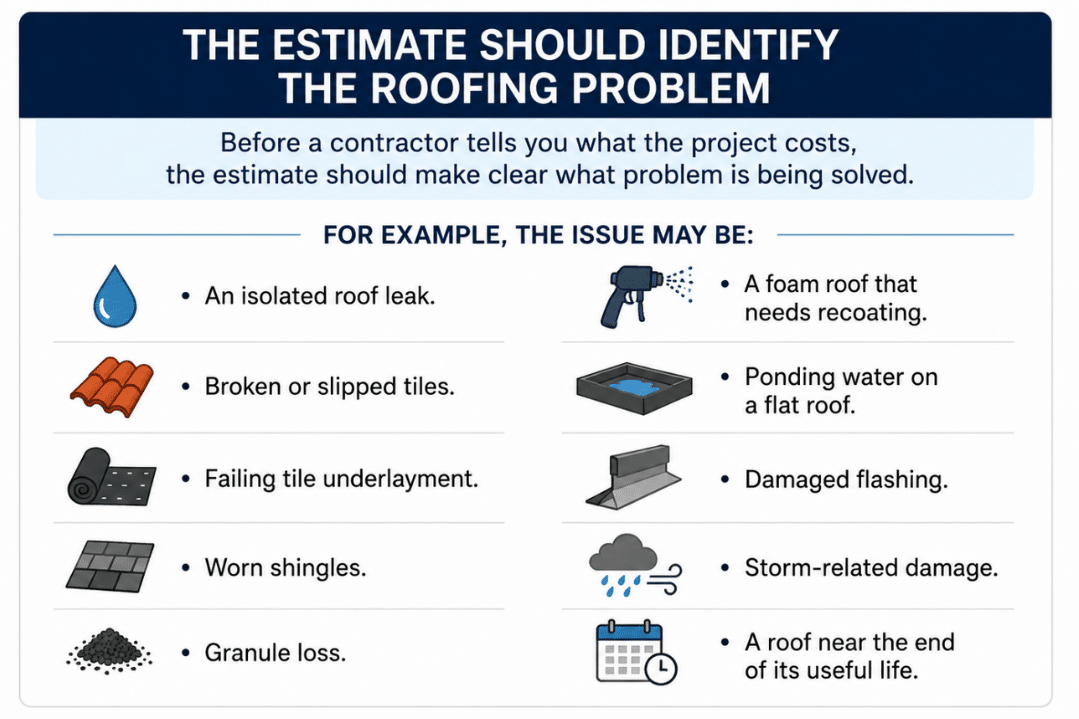
The most important part of a roofing estimate is the diagnosis.
Before the estimate explains the price, it should explain the problem being solved.
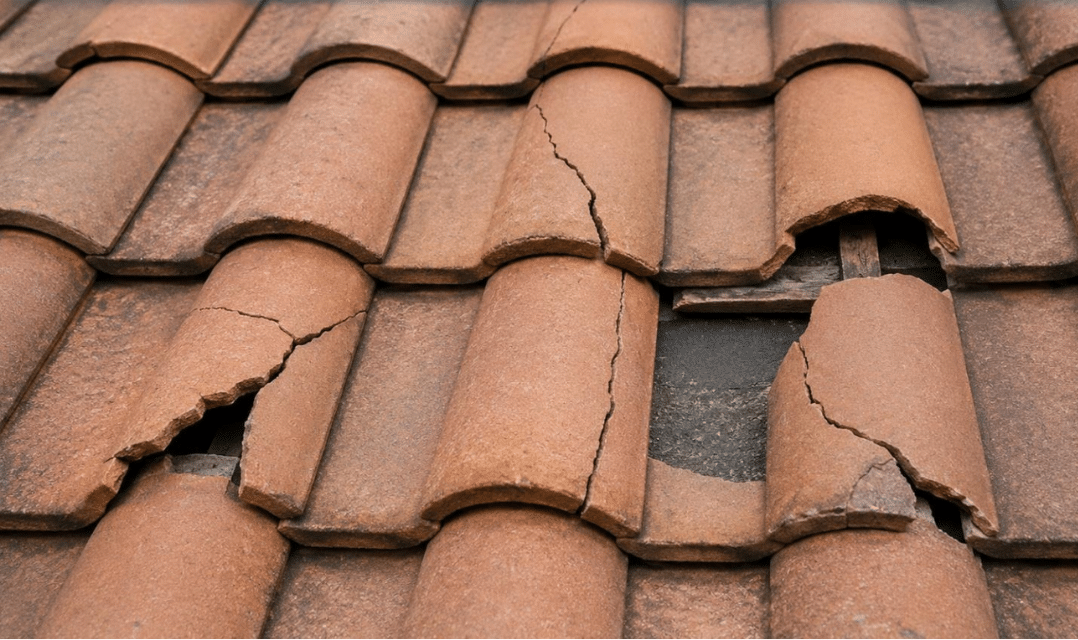
Is the issue an isolated leak? Broken or slipped tile? Failing underlayment? Damaged flashing? Ponding water on a flat roof? Worn shingles? Foam coating that needs recoating? Storm damage? A roof near the end of its useful life?
The estimate should make that clear.
This matters because different problems require different solutions. A small leak around a vent may not need the same solution as widespread failing underlayment. A roof with one damaged section may not need the same scope as a roof with multiple problem areas. A foam roof with thin coating may need a recoat, while a foam roof with damaged or deteriorated foam may need restoration or replacement.
A good diagnosis helps you understand whether the contractor is recommending the right level of work.
It also helps you compare estimates more fairly. If one contractor explains the problem clearly and another only gives you a number, you are not really comparing the same kind of proposal.
The Scope of Work Should Be Clear
The scope of work explains exactly what the contractor plans to do.
For a roof repair, the scope should explain the affected area, the likely cause of the problem, the repair method, and whether the repair is expected to be a long-term fix or a temporary solution.
For a partial replacement, the scope should define which roof section is being replaced, how it connects to the remaining roof, and what risks remain in the areas not being replaced.
For a full roof replacement, the scope should explain whether the old roof will be removed, what new system will be installed, what components are included, and how the home will be protected during the project.
For a tile lift-and-reset, the estimate should explain whether the existing tile will be removed and reused, what underlayment will be installed, how broken tile will be handled, and which components may be replaced or reused.
For a foam roof, the estimate should explain whether the project is a repair, recoat, restoration, or replacement.
A vague scope leaves too much room for confusion later. For example, “repair roof leak” may sound simple, but it does not tell you where the repair is, what materials will be used, how much area is included, whether damaged wood is included, or what happens if the leak returns.
A clear scope protects both the homeowner and the contractor. Everyone understands what is included before the work begins.
The Estimate Should Name the Materials Being Used
A roofing estimate should not use vague language like “quality materials,” “standard underlayment,” or “roofing materials” without explaining what that means.
The materials matter.
On a tile roof, the estimate should identify the underlayment being used. This is especially important in Phoenix because the underlayment beneath the tile is the main waterproofing layer. One contractor may include a basic underlayment, while another may include a higher-grade product better suited for Arizona heat.
On a shingle roof, the estimate should identify the shingle product, underlayment, starter material, ridge material, ventilation components, and flashing details.
On a foam roof, the estimate should explain whether the job is a repair, recoat, restoration, or new foam system. It should also explain the coating system, prep work, and repairs included.
On a flat roof, the estimate should identify whether the system is foam, TPO, modified bitumen, built-up roofing, coating, or another solution.
Material names and system details affect price, performance, maintenance, and warranty coverage. If one estimate names the system clearly and another uses generic wording, ask for clarification before comparing the final price.
The Estimate Should Explain What Is Included and Excluded
A good roofing estimate should make the included work easy to understand.
Depending on the project, included work may involve tear-off, disposal, underlayment, flashing, drip edge, battens, bird stops, vents, pipe jacks, skylight details, valley metal, foam coating, membrane details, surface preparation, fasteners, permits, cleanup, magnetic sweeps, final inspection, and photo documentation.
Not every item applies to every roof. A tile roof estimate will look different from a foam roof estimate. A repair estimate will look different from a full replacement estimate.
The point is that the estimate should be specific enough that you know what the contractor is including in the price.
Exclusions matter just as much.
A roofing estimate should tell you what is not included in the price, or what may become an additional cost if discovered during the project. This may include rotten decking, fascia replacement, stucco repair, interior drywall or paint repair, gutter work, solar panel removal, AC work, skylight replacement, structural repairs, extra tile replacement, or hidden damage beneath the existing roof.
Exclusions are not automatically a red flag. Some things cannot be fully known until the roof is opened.
The red flag is when the estimate does not explain how those issues will be handled.
A clear estimate does not pretend there will never be surprises. It explains the process for handling them.
The Estimate Should Explain Flashings and Roof Components
Flashings and roof components can create confusion because the right answer is not always “replace everything.”
Some components may need to be replaced. Others may be reusable if they are still in good condition and appropriate for the roof system.
For example, certain wall flashings may be reusable. In other cases, flashings may need to be replaced because they are damaged, missing, or no longer appropriate for the roof system.
The estimate should explain whether flashings, vents, battens, drip edge, bird stops, pipe jacks, skylight details, or other components are being replaced, reused, or replaced as needed.
This matters because two estimates may handle these details differently.
One contractor may include replacement of more components. Another may reuse certain items to avoid unnecessary cost or avoid disturbing stucco, wall details, or finishes that do not need to be opened. Both approaches can be reasonable depending on the condition of the roof.
The problem is not reuse by itself. The problem is when the estimate does not explain what is being reused and why.
The Estimate Should Explain How Hidden Damage Is Handled
Hidden damage is common in roofing.
A contractor may inspect the roof carefully and still not see everything until old materials are removed. Damaged decking, dry rot, moisture damage, poor previous repairs, or hidden structural problems may only appear after the project begins.
The estimate should explain what happens if that occurs.
The homeowner should know whether hidden damage will be documented with photos, how added work will be priced, whether approval is needed before the work continues, and whether there is any allowance for wood replacement or decking repair.
This is especially important because hidden damage can change the final cost.
A detailed estimate does not eliminate that risk, but it helps you understand how the contractor will handle it. That can prevent frustration later if the project uncovers damage that could not be seen during the original inspection.
The Estimate Should Explain the Warranty
A roofing estimate should clearly explain the warranty.
There are usually two warranty categories homeowners need to understand: material warranties and workmanship warranties.
A material warranty comes from the manufacturer and relates to the roofing product itself. A workmanship warranty comes from the contractor and relates to the installation work.
Those are not the same thing.
A long manufacturer warranty does not automatically mean every future leak is covered. A workmanship warranty does not always cover interior damage, maintenance-related issues, storm damage, or problems caused by other trades.
Before signing, make sure you understand what warranty applies, who is responsible for honoring it, what is excluded, whether maintenance is required, and whether the warranty is transferable if the home is sold.
A roofing estimate should not leave warranty protection vague.
For more detail, see our guide to Roof Warranties in Plain English.
The Estimate Should Include Contractor Information
A roofing estimate should clearly identify the contractor.
At minimum, it should include the company name, contact information, and Arizona ROC license number.
This does not tell you whether the contractor is the best fit for your specific roof, but it does give you a basic way to verify the company before moving forward.
Hiring a licensed contractor does not guarantee a perfect project. But hiring an unlicensed contractor can remove an important layer of protection if something goes wrong.
The Estimate Should Explain Timeline, Cleanup, and Property Protection
The estimate should give you a realistic sense of when the project may start, how long the work is expected to take, and what could cause delays.
Roofing timelines can vary based on the roof system, project size, weather, material availability, HOA approval, and hidden damage. A simple repair may be quick, while a tile reset, foam roof, flat roof, or complex replacement may take longer.
The proposal should also explain how the contractor will protect the home during the work, including areas like the driveway, landscaping, pool, patios, pets, gates, and access points.
It should also explain whether tear-off, haul-away, disposal, dump fees, and cleanup are included. Roofing creates debris, so the homeowner should understand how the property will be cleaned up after the work is done.
A good estimate should make the project feel more predictable, not leave you guessing.
For more detail, see our article on How Long a Roof Replacement Takes in Phoenix.
The Estimate Should Explain Payment Terms and Price Expiration
A roofing estimate should clearly explain how payment works.
That may include the deposit, progress payments, final payment, accepted payment methods, and when payment is due.
If financing is available, the proposal should explain that financing is an option, not pressure. The homeowner should understand the project cost, scope of work, and financing terms before making a decision.
Avoid making a decision based only on monthly payment. A lower payment may still involve a larger total cost depending on the financing terms.
The estimate should also include a price expiration date. Material costs, labor costs, supplier pricing, and availability can change. If an estimate is valid for 15, 30, or 60 days, that should be stated clearly.
A price expiration date does not mean the contractor is pressuring you. It means the contractor is being clear about how long the quoted price can reasonably be honored.
Red Flags in a Roofing Estimate
A low estimate is not automatically bad. A high estimate is not automatically better.
The issue is whether the estimate clearly explains the problem, the proposed solution, and what is included.
Be cautious if the estimate gives only a price with little explanation, does not show photos or evidence of the roof problem, does not explain the scope of work, uses vague phrases like “standard materials,” does not identify the materials being used, does not say what is excluded, does not explain how hidden damage will be handled, does not include contractor license information, or pressures you to sign before you understand the proposal.
Another red flag is an estimate that is dramatically lower than the others without explaining why. It may be a better price, but it may also leave out materials, prep work, flashing, cleanup, warranty coverage, or hidden damage procedures.
A roofing estimate does not need to be complicated, but it does need to be clear. You should understand what problem the contractor found, how they plan to fix it, and what you are paying for.

What to Ask Before Accepting a Roofing Estimate
Before accepting a roofing estimate, ask the contractor to walk you through the proposal.
Start with the diagnosis. Ask what problem they are solving and what evidence supports that recommendation. If photos or video are available, ask to see them.
Then ask what exactly is included in the price. Ask what materials are being used, what is excluded, what happens if hidden damage is found, what warranty applies, whether flashings and components are being replaced or reused, how cleanup is handled, and how the project will be handled from start to finish.
If you have another estimate, ask why the two prices may be different. The difference may be scope, material, warranty, project access, hidden damage assumptions, HOA requirements, cleanup, or the level of documentation and preparation included.
A contractor should be able to answer these questions clearly. If the explanation is vague, the estimate may not be ready for approval.
Bottom Line
A roofing estimate should not leave you guessing.
It should show what is wrong with the roof, explain why the work is being recommended, describe the scope, name the materials, clarify what is included and excluded, explain how hidden damage will be handled, outline the warranty, identify the contractor, and make the project process clear.
The cheapest estimate is not always the best value. The most expensive estimate is not automatically the best roof.
The best estimate is the one that helps you understand what you are buying, why it is being recommended, and how it protects your home.
What to Do Next
If you are comparing roofing estimates, slow down and compare the details before comparing the final number.
At Renco Roofing, we provide detailed proposals so homeowners can understand the roof condition, scope, materials, cost, warranty, exclusions, and options clearly before making a decision.
If you are unsure whether two estimates are actually offering the same roof, ask for clarification. A roofing estimate should make your decision easier, not more confusing.