Jeff Nickerson, Technical Roofing Consultant
Last Updated: July 2026
The Quick Answer
For many Phoenix homes with flat or low-slope roof areas, spray polyurethane foam, often called SPF or foam roofing, is one of the strongest options to consider.
Foam creates a seamless roof surface, works well around penetrations and irregular roof details, adds insulation value, and can be renewed through future coating maintenance. For residential flat roofs in Phoenix, those advantages matter.
But foam is not the only option.
TPO, modified bitumen, and built-up roofing can also be good systems in the right situation. TPO is a single-ply membrane that handles foot traffic well and is often seen more in commercial roofing. Modified bitumen is an asphalt-based rolled membrane that may fit certain existing roofs or project goals. Built-up roofing, often called BUR, is a traditional multi-layer asphalt system that may be more expensive, but can require less routine maintenance than some other flat-roof options.
The best system depends on your roof, your budget, your maintenance expectations, how visible the roof is, how much foot traffic it gets, and what you want from the roof long term.
A contractor should not recommend a flat-roof system just because it is the product they prefer to install. They should evaluate the existing roof, drainage, ponding water, scuppers, parapet walls, AC units, penetrations, previous repairs, damaged areas, and how the roof will be used.
The goal is not to choose the roofing material that sounds best online. The goal is to choose the roofing system that makes the most sense for your home.
A Flat Roof Is Different from a Tile or Shingle Roof
When homeowners think about roofing, they often picture tile or shingles. Those materials are common on sloped roof areas where gravity helps move water down and off the home.
A flat roof works differently.
Most flat roofs are not perfectly flat. They are usually low-slope roofs designed to move water toward drains, scuppers, or roof edges. But water moves away more slowly than it does on a pitched roof.
That changes the decision.
On a flat roof, the waterproofing surface has to protect a larger exposed area. The details also matter more because water has more time to find weak points.
Common problem areas include:
- Scuppers
- Drains
- Parapet walls
- AC units
- Pipes
- Skylights
- Seams
- Edges
- Previous repair areas
- Areas where debris collects
That is why choosing a flat-roof system is not just about picking a material. It is about choosing a complete system that fits the roof and the way the home is used.
For Phoenix homeowners, four systems usually come up in flat-roof conversations:
- Spray polyurethane foam, or SPF
- TPO membrane roofing
- Modified bitumen roofing
- Built-up roofing, often called BUR
Each system can work. The important question is which one fits your roof, your budget, and your expectations.
What a Roofer Looks at Before Recommending a Flat-Roof System
Before recommending foam, TPO, modified bitumen, or BUR, a contractor should look at more than the roof surface.
One factor homeowners may not think about is appearance.
In some Phoenix-area neighborhoods, flat roofs are visible from the street, from nearby hillside homes, or from elevated lots. Because we live in a valley with different elevations, some roofs can be seen more clearly than homeowners expect. A system may perform well but still look less appealing from certain angles.
That does not mean appearance should matter more than performance. It just means it should be part of the conversation when the roof is visible.
Budget is another factor.
Flat-roof systems come at different price points. Some may cost more upfront but last longer or require less maintenance. Others may be more budget-friendly but require more attention over time.
The real question is: what do you want from the roof?
Some homeowners want the best long-term performance. Some want the lowest maintenance. Some want the best value for the dollar. Some need to solve a leak or drainage issue without overbuilding the project.
A good recommendation should weigh all of that together.
Spray Polyurethane Foam Roofing
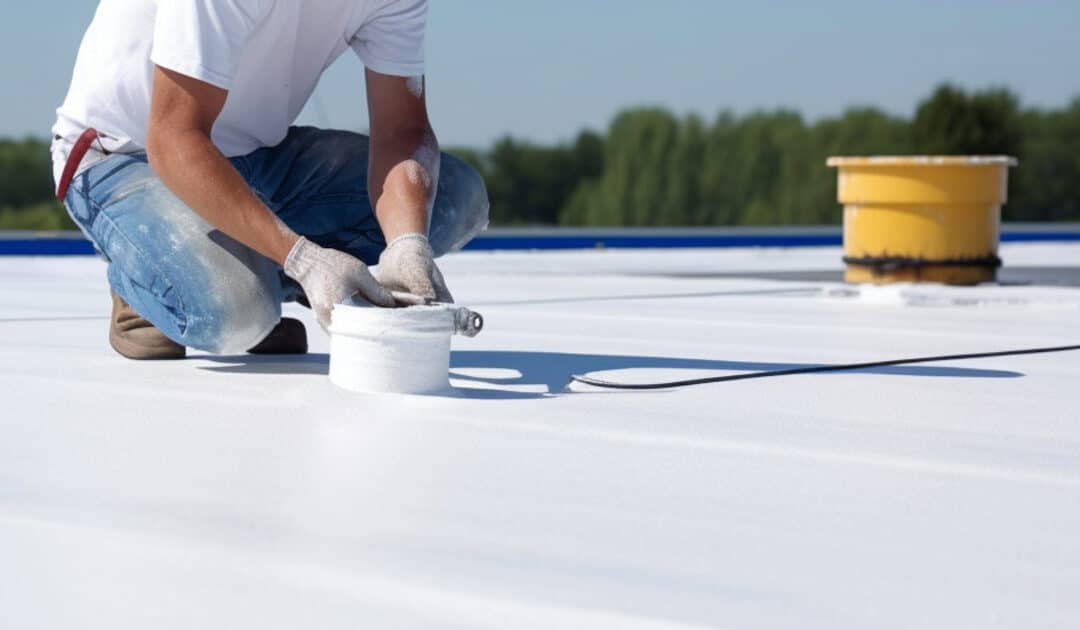
Spray polyurethane foam roofing is installed by spraying a liquid material onto the roof surface. The material expands into a rigid foam layer, then receives a protective coating over the top.
That coating is not optional. It is a critical part of the system.
The foam creates the seamless, insulated roofing layer. The coating protects the foam from sun exposure, weather, and wear. Over time, that coating needs to be inspected and renewed so the foam underneath remains protected.
For Phoenix residential flat roofs, foam has several major advantages.
First, it is seamless. That matters because seams are often one of the weak points on flat roofs. Foam is sprayed in place, so it can form a continuous surface across the roof.
Second, foam works well around complicated roof details. Many flat roofs have pipes, AC curbs, drains, scuppers, skylights, parapet walls, and transitions. Because foam is applied directly around those details, it can be a strong fit for roofs with irregular layouts.
Third, foam adds insulation value. In Phoenix, where the roof takes on intense heat for much of the year, that can be a meaningful benefit.
Fourth, foam is relatively easy to maintain when maintenance is actually needed. If the coating wears down, the roof may be able to be recoated instead of completely replaced, assuming the underlying foam is still in good condition.
That is why foam is often one of the best starting points for a Phoenix residential flat roof.
But foam is not maintenance-free.
If a homeowner wants to install a flat roof and ignore it for 20 years, foam may not match that expectation. The roof should be inspected, kept clean, and recoated when the protective coating reaches the end of its service life.
If the coating becomes thin, cracked, worn, or damaged, the foam underneath can be exposed to the sun. That can shorten the life of the system.
Foam can be one of the best-performing flat-roof systems in Phoenix, but only when it is installed correctly and maintained properly.
When Foam Roofing May Be the Best Fit
Foam may be a strong fit when the roof has:
- Several penetrations
- AC units or curbs
- Pipes or vents
- Scuppers or drains
- Parapet walls
- Irregular roof shapes
- Multiple transitions
- A need for additional insulation value
- A homeowner willing to keep up with coating maintenance
Foam may also make sense when the existing roof can be restored instead of fully removed and replaced. That depends on the condition of the roof, whether moisture is trapped beneath the surface, and whether the existing system is compatible with foam.
Foam is not always the answer, but for many Phoenix residential flat roofs, it gives homeowners a strong combination of performance, value, insulation, and maintainability.
TPO Roofing
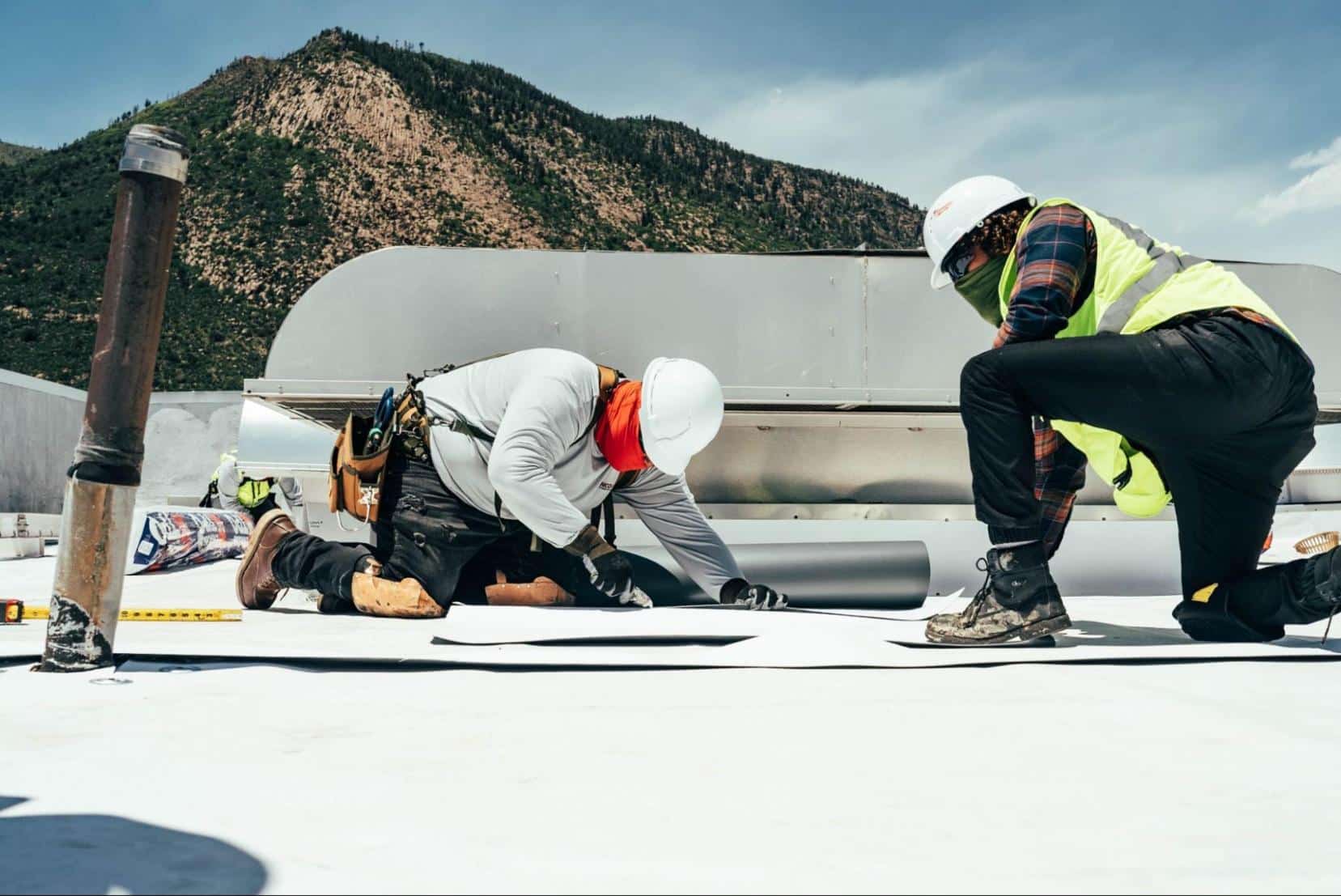
TPO stands for thermoplastic polyolefin. It is a single-ply roofing membrane, which means the waterproofing layer is installed in large sheets rather than built up through multiple asphalt-based layers.
TPO is usually white or light colored, which makes it a reflective roofing option. The sheets are joined together with heat-welded seams.
When installed properly, those seams create a continuous membrane across the roof surface.
TPO can be a good roofing system, but it is often more common in commercial roofing than residential roofing. One reason is foot traffic. Commercial roofs often have more equipment, more service activity, and more people walking on them. TPO can handle that kind of use well when properly installed.
On a typical residential flat roof, foot traffic is usually less important. Many homeowners only have someone on the roof occasionally for an inspection or AC service. In that case, foot traffic may not be the deciding factor.
That does not mean TPO is bad for residential roofing. It means the roof layout and use case should justify it.
TPO may be worth considering when:
- The roof has a clean, simple layout
- The homeowner wants a reflective sheet membrane
- The seams, edges, penetrations, and walls can be detailed properly
- The installer is experienced with heat-welded seams
- The roof may see more foot traffic than usual
The important thing to understand is that TPO is not just white material rolled across the roof.
The system depends heavily on seams, terminations, flashings, attachment methods, penetrations, and drainage details. If those details are weak, the membrane name does not protect the homeowner.
For many Phoenix residential flat roofs, foam may be the stronger value. But TPO can still be appropriate when the roof layout, budget, and homeowner priorities fit the system.
Modified Bitumen Roofing
Modified bitumen is an asphalt-based roofing membrane that comes in rolls. It is related to traditional built-up roofing, but instead of building the entire system layer by layer on the roof, the membrane is manufactured as a finished rolled material.
Modified bitumen may be installed in different ways depending on the system. Some products are torch-applied, some use cold adhesive, and some are self-adhered.
Modified bitumen can be appropriate when an asphalt-based membrane fits the existing roof, the project scope, or the homeowner’s goals.
It may come up on older flat roofs, patio roofs, additions, garages, or areas where an asphalt-based system has already been used.
For Phoenix homes, the surface matters. A dark or poorly surfaced roof can absorb a lot of heat. That can affect comfort, aging, and long-term performance.
A homeowner comparing modified bitumen with foam or TPO should ask:
- How will this system handle Phoenix sun exposure?
- How are seams and laps installed?
- How are penetrations and scuppers detailed?
- What kind of maintenance will it need?
- How easy will future repairs be?
- Is this system compatible with what is already on the roof?
Modified bitumen is not automatically better or worse than the other options. It is one more system that needs to be matched to the roof.
Built-Up Roofing
Built-up roofing, or BUR, is one of the more traditional flat-roof systems.
It is made from multiple layers of asphalt and reinforcing material. Those layers are built up on the roof to create the waterproofing assembly, usually with a protective surface on top.
The main advantage of BUR is redundancy. Instead of relying on one membrane layer or one sprayed layer, BUR uses multiple layers.
That can make it a durable system.
For homeowners who want a roof that may require less routine maintenance, BUR may be worth considering. Compared with foam, TPO, or modified bitumen, BUR may be one of the lower-maintenance flat-roof options when installed correctly.
But there are tradeoffs.
BUR can be more expensive. It can also be more labor-intensive. Depending on the home, it may add more weight than other systems. The existing roof structure, access, drainage, and project scope all need to be considered.
A built-up roof may make sense for some Phoenix homes, but homeowners should not assume that an older built-up roof must be replaced with another built-up roof.
The existing roof should be evaluated first. In some cases, BUR may still be a good fit. In other cases, foam, TPO, modified bitumen, restoration, or removal and replacement may make more sense.
Foam vs. TPO vs. Modified Bitumen vs. BUR
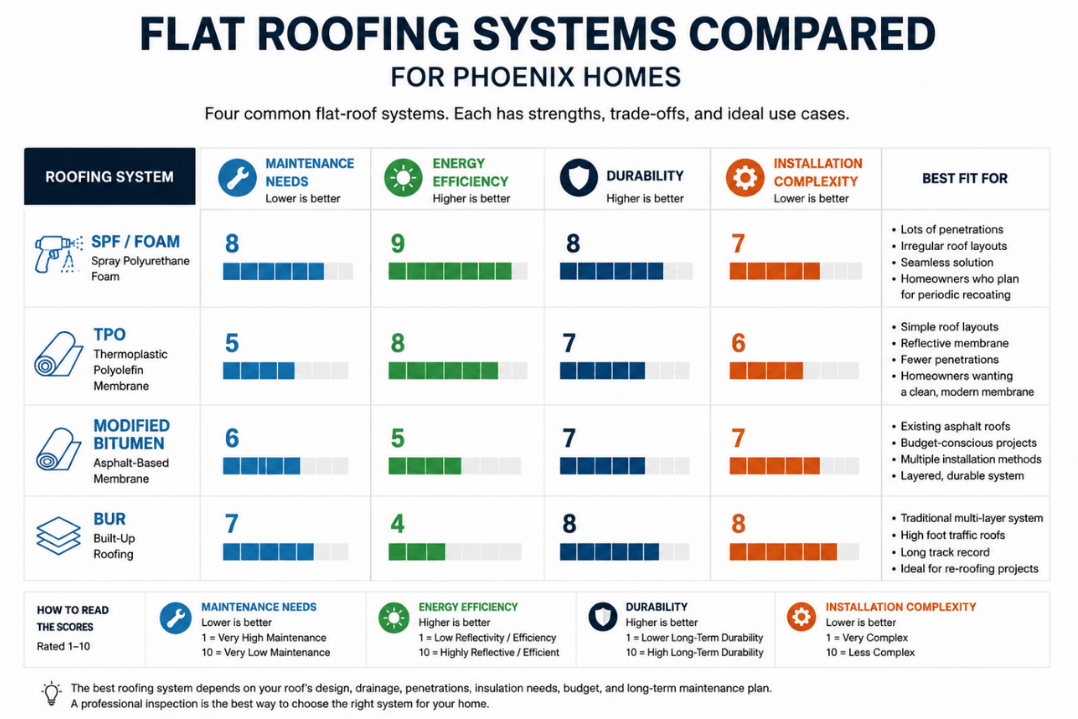
Here is a simple way to compare the four systems.
|
Roofing System |
Why a Homeowner May Consider It |
What Needs Careful Attention |
|
Spray Polyurethane Foam / SPF |
Seamless application, works well around penetrations and irregular details, adds insulation value, can be renewed through coating maintenance, often strong value for Phoenix residential flat roofs. |
Coating condition, recoating schedule, installer skill, punctures, surface damage, drainage, debris, and whether the existing roof is suitable for foam. |
|
TPO |
Reflective single-ply membrane, heat-welded seams, strong foot-traffic performance, often used in commercial roofing. |
Seam quality, penetrations, edge details, flashing, attachment method, drainage, repair compatibility, and whether the roof layout fits a sheet membrane system. |
|
Modified Bitumen |
Asphalt-based rolled membrane that may fit certain existing roofs, additions, patios, garages, or project goals. |
Surface reflectivity, seams and laps, installation method, penetrations, heat exposure, future repairs, and compatibility with the existing roof. |
|
Built-Up Roofing / BUR |
Traditional multi-layer asphalt system with built-in redundancy and potentially lower routine maintenance. |
Cost, weight, installation complexity, existing roof assembly, surfacing, drainage, and whether removal or replacement is needed. |
The main takeaway is that each system can work in the right situation.
The wrong installation, poor drainage, blocked scuppers, weak seams, or ignored maintenance can create problems no matter which material is chosen.
Phoenix Heat and Monsoon Storms Change the Decision
In some climates, choosing a flat-roof system may come down mostly to material preference and budget.
In Phoenix, the environment makes the decision more specific.
A flat roof is exposed directly to long periods of sun and high temperatures. That makes the protective surface especially important.
For foam, that means the coating has to be maintained. For TPO, the membrane and seams need to hold up under heat exposure. For modified bitumen, the surface and reflectivity matter. For BUR, the protective surfacing and drainage details matter.
Monsoon storms also expose weak points.
A roof can look fine during dry weather and still have problems when wind-driven rain hits the roof. Water can find openings around scuppers, drains, walls, penetrations, seams, edges, and old repair areas.
That is why a flat roof succeeds or fails at the details.
A proposal should not just say “foam roof” or “TPO roof.” It should explain how the system will handle the vulnerable areas on that specific home.
Debris Is One of the Biggest Flat-Roof Problems
One of the most common flat-roof problems in Phoenix is not the roofing material itself.
It is debris.
Leaves, branches, dirt, landscaping debris, and other material can collect on a flat roof. Because the roof is low-slope, that debris may not wash away easily.
When debris collects, it can block drains and scuppers. Once that happens, water can back up and sit on the roof. In a heavy storm, a flat roof can start acting like a bathtub.
That standing water can stress the roofing system, find weak points, and create leak risks.
Debris can also attract birds. Birds may use the material for nesting or shelter, which adds more mess and more opportunity for water to collect.
This is why flat roofs need to be kept clean.
No matter which system you choose, foam, TPO, modified bitumen, or BUR, the roof should be checked regularly and cleared of debris. A good roofing system can still have problems if drainage is blocked.
Ponding Water Should Not Be Ignored
Ponding water is a drainage issue, not just a material issue.
If water consistently collects on parts of the roof, the contractor should figure out why.
The issue may involve slope, drains, scuppers, blocked drainage paths, low areas, roof transitions, structural conditions, or debris.
Some roofing systems may allow adjustments that improve drainage in certain situations. Foam, for example, may allow some shaping during installation to help improve water flow when the roof conditions allow for it.
But homeowners should be cautious if a proposal ignores ponding water and simply promises that a new material will solve everything.
A new waterproofing surface can help protect the home, but it should not be used as a substitute for understanding why water is staying on the roof.
The Existing Roof May Matter as Much as the New Material
Homeowners often start by asking, “Should I choose foam or TPO?”
That is a fair question, but it is not the first question a contractor should answer.
Before choosing a new system, the contractor needs to understand what is already on the roof.
Important questions include:
- What type of flat-roof system is currently installed?
- Is the roof leaking?
- Is there trapped moisture beneath the surface?
- Is the roof deck sound?
- Are there several previous repairs or layers?
- Does the roof hold water after storms?
- Are drains, scuppers, and edges working properly?
- Are there many penetrations or roof-mounted units?
- Can the current roof be restored, or does it need removal?
In some cases, a homeowner may not need a completely new roofing system. A foam roof with an aging but serviceable coating may need maintenance or restoration instead of full replacement.
In other cases, trapped moisture, deterioration, repeated failures, incompatible materials, or poor drainage may make removal and replacement the better recommendation.
The inspection should answer that before the homeowner is asked to choose between products.
Questions to Ask Before Choosing a Flat-Roof System
A roofing proposal should do more than name a product.
Before signing a contract, ask these questions:
|
Question to Ask |
Why It Matters |
|
What type of flat-roof system is currently on my home? |
The existing roof affects whether restoration, covering, removal, or replacement is appropriate. |
|
Why are you recommending this system instead of the other options? |
The recommendation should be based on your roof, not just the contractor’s favorite product. |
|
How will you address ponding water or drainage issues? |
A new waterproofing surface does not automatically correct poor drainage. |
|
How will you handle scuppers, drains, parapet walls, AC units, pipes, skylights, and other penetrations? |
These are common areas where workmanship and detailing matter most. |
|
What maintenance will this roof need? |
Every system has ownership requirements. Foam coating maintenance is especially important to understand. |
|
How often should the roof be inspected or cleaned? |
Debris and blocked drainage are common causes of flat-roof problems. |
|
Does any existing roofing material need to be removed? |
Removal can affect scope, cost, and long-term performance. |
|
What warranty covers the material, and what warranty covers the installation? |
A product warranty and workmanship warranty do not protect the homeowner in the same way. |
These questions help you compare the full system, not just the material name or final price.
[For more on comparing proposals, see Why Some Roofing Quotes Are Cheaper Than Others.]
What a Better Flat-Roof Decision Looks Like
A better flat-roof decision does not always mean choosing the newest system or the most expensive one.
It means you understand:
- What is currently on your roof
- What problem needs to be solved
- Which systems fit the roof
- What each system costs
- What maintenance each option requires
- How visible the finished roof will be
- How the roof drains
- Whether repair, restoration, or replacement makes the most sense
When you have that information, you can compare foam, TPO, modified bitumen, and BUR more clearly.
You may decide that foam gives you the best overall value. You may decide that BUR makes sense because you want a lower-maintenance asphalt-based system. You may decide that TPO fits the roof layout or traffic needs. Or you may learn that the existing roof can be restored instead of replaced.
That is the difference between buying a roofing product and choosing a roof system that makes sense for your home.
So, Which Flat-Roof System Is Best for a Phoenix Home?
For many Phoenix residential flat roofs, foam is often the strongest place to start.
It is seamless, works well around complicated roof details, adds insulation value, and can be maintained through future coating renewal. When installed correctly and maintained properly, foam can provide strong long-term performance and value for the dollar.
But foam is not the automatic answer for every home.
TPO may be a better fit when a reflective sheet membrane is preferred and the roof layout supports a clean membrane installation. It may also make sense where foot traffic is a bigger concern.
Modified bitumen may be appropriate when an asphalt-based rolled membrane fits the existing roof, budget, or project goals.
Built-up roofing may make sense when the homeowner wants a traditional multi-layer system and understands the higher cost, installation complexity, and potential maintenance advantages.
The best choice depends on what the inspection reveals:
- What is already on the roof
- Whether moisture or structural damage is present
- How well the roof drains
- How much debris collects on the roof
- Whether scuppers and drains are working
- How many penetrations and complicated transitions exist
- Whether the roof is visible from the street or nearby homes
- Whether restoration is possible
- What maintenance the homeowner is willing to plan for
- What the contractor can clearly explain and properly install
A contractor should be able to show why one option fits your home better than the others.
If the answer is simply, “This is what we always install,” you do not have enough information to make a confident decision.
What to Do Next
If your Phoenix home has a flat or low-slope roof and you are deciding between foam, TPO, modified bitumen, or built-up roofing, start with an inspection of the existing roof.
Do not choose a material from a brochure or online comparison before understanding the roof itself.
At Raving Roofs, we evaluate the roof surface, drainage, penetrations, scuppers, parapet walls, previous repairs, signs of trapped moisture, debris buildup, and the existing roofing system before recommending a solution.
Then we explain which options fit your home, what each one involves, and what maintenance and cost expectations you should understand before moving forward.
Maybe your roof needs a new system. Maybe it can be restored or maintained. Maybe one system clearly fits better than the others.
Either way, you should understand what you are buying and why it makes sense for your home.