Shane Simonson, Residential Projects General Manager
Last Updated: July 1st, 2026
The Quick Answer
A long roof warranty does not automatically mean your entire roof is protected from leaks or repair costs for that full period.
Most roofing projects involve two different types of coverage:
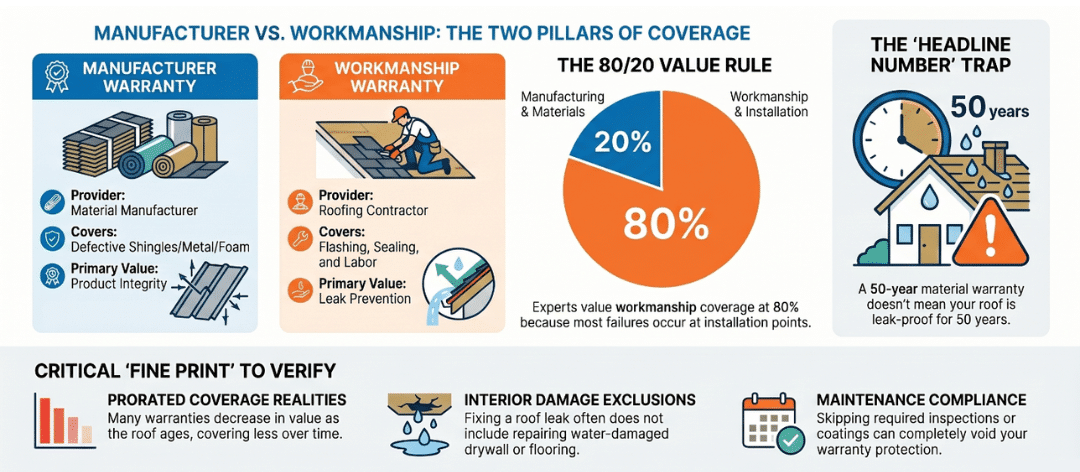
- A manufacturer warranty, which generally covers defects in the roofing material itself.
- A workmanship warranty, which comes from the roofing contractor and covers installation-related problems under the terms of that warranty.
Both matter. But if a roof leaks because of how flashing, underlayment, penetrations, transitions, or drainage details were installed, the contractor’s workmanship warranty may be the protection that matters most.
Before choosing a roof based on a “30-year,” “50-year,” or “lifetime” warranty, ask what the warranty actually covers, whether the coverage decreases over time, what maintenance is required, whether labor or interior damage is included, and who will respond if there is a problem later.
Warranty 101: Why the Number of Years Can Be Misleading
Warranty language is easy to misunderstand because the headline number is usually the part homeowners notice first.
A 30-year manufacturer warranty may tell you something useful about the product being installed. But it does not necessarily promise that your home will be leak-free for 30 years or that every cost will be paid if a problem occurs.
A roof can leak even when the material itself is not defective. The issue may come from incorrect flashing, poorly installed underlayment, an improperly sealed penetration, a drainage detail, or another installation problem.
That is why the first question should not be only, “How long is the warranty?”
A better starting point is: “What exactly does this warranty cover, and who is responsible if my roof has a problem?”
The Two Warranties Homeowners Need to Understand
| Warranty Type | Who Provides It? | What It Generally Covers |
|---|---|---|
| Manufacturer warranty | The material manufacturer | Defects in the roofing product itself |
| Workmanship warranty | The roofing contractor | Covered problems related to how the roof was installed |
Manufacturer Warranty: Coverage for the Product
A manufacturer warranty generally applies when a roofing product fails because of a defect in that product.
For example, a shingle, coating, metal finish, or underlayment product may have manufacturer coverage if it fails prematurely under the warranty terms.
That coverage is important. Quality materials are part of a durable roofing system.
But a manufacturer warranty is not usually the same as a guarantee that the completed roof will never leak. If the material is fine but the roof was installed incorrectly, the manufacturer may not be responsible for the resulting problem.
Workmanship Warranty: Coverage for the Installation
A workmanship warranty comes from the contractor who installed the roof.
This is the warranty homeowners may need if the problem comes from the installation: flashing details, penetrations, underlayment, transitions, sealing, drainage, or other work performed by the roofing company.
The exact protection depends on the written warranty. Some workmanship warranties are broad. Others include significant exclusions. The homeowner should know what the contractor is promising before the work begins.
Workmanship Coverage Deserves Special Attention
Jeff, one of our roofing experts, puts it this way: if he were choosing a roof for his own home, he would place roughly 80% of the warranty value on the workmanship warranty and 20% on the manufacturer warranty.
That is his professional perspective, not a universal formula. The point is that excellent materials still depend on proper installation.
A strong manufacturer warranty tells you that the product has value. A strong workmanship warranty tells you whether the contractor is willing to stand behind the roof system they actually built on your home.
This matters in Phoenix because roofs are exposed to intense heat, constant sun, wind, dust, and monsoon rain. Small installation weaknesses around waterproofing layers, flashing, transitions, penetrations, or drainage areas can become expensive problems once water gets in.
When comparing roofing proposals, do not ask only which contractor offers the longest warranty. Ask which company clearly defines its workmanship coverage and has the experience and stability to stand behind it.
What “Prorated” Coverage Means
Many manufacturer warranties are limited or prorated over time.
A prorated warranty means the coverage may decrease as the roof gets older. Early in the warranty period, the manufacturer may cover more of the product cost. Later, coverage may be reduced to a smaller portion of the replacement material.
The homeowner may still be responsible for labor, tear-off, disposal, installation, or other costs, depending on the warranty.
That difference can be significant. Reaching a failed layer beneath a tile roof, for example, may involve removing and resetting tile. Replacing shingle materials still involves labor and disposal. Maintaining a foam roof may require documented coating work over time.
Before relying on a long warranty period, ask:
- Is the coverage prorated?
- When does the full coverage period end?
- Does the warranty pay for labor or only material?
- Are tear-off, disposal, or reinstallation costs included?
- What documentation is required if a claim is made?
A long warranty may still be worthwhile. You simply need to understand what the coverage will realistically provide over time.
Every Warranty Has Its Limits: Beware These 3
A Covered Leak May Not Mean Covered Interior Damage
A workmanship warranty may address an installation-related roof leak but still exclude the damage caused inside the home.
If water stains drywall, damages paint, affects flooring, wets insulation, or harms personal property, those costs may or may not be covered under the contractor’s warranty.
Ask this directly:
“If my roof leaks because of an installation problem, will you repair only the roof, or will you also address resulting damage inside the home?”
The answer should be in writing.
Maintenance Requirements Can Affect Coverage
Some roof systems require ongoing maintenance to protect both performance and warranty eligibility.
This is especially important with foam roofs. The protective coating over the foam wears over time and may need to be renewed. If required maintenance is skipped or cannot be documented, warranty coverage may be limited or denied under the warranty terms.
Other roofing warranties may include requirements involving inspections, ventilation, third-party repairs, debris removal, storm damage, or modifications made after installation.
Ask what maintenance is required, who may perform it, what records you should keep, and what actions could affect your coverage.
Will The Contractor Be Around to Honor the Warranty?
A workmanship warranty is only practical if the company behind it is still operating and willing to respond when a problem occurs.
A newer roofing contractor is not automatically a bad choice. Every established company started somewhere. But a homeowner should understand the tradeoff: a contractor with a long track record may give you more confidence that warranty service will still be available years from now.
Ask how long the company has been operating, who handles warranty claims, and what happens to the workmanship warranty if the company is sold or changes ownership.
Warranty Questions Change Depending on Your Roof Type
Different roof systems create different warranty questions. You do not need to become a roofing expert, but you should understand what part of the system matters most.
| Roof Type | Warranty Detail to Ask About |
|---|---|
| Tile roof | What warranty applies to the underlayment beneath the tile, and what installation requirements must be followed? |
| Foam roof | What coating maintenance or recoating is required to maintain coverage? |
| Shingle roof | When does manufacturer coverage become prorated, and does it include labor or only material? |
| Metal roof | Does the warranty apply to the finish, the panels, leaks, installation workmanship, or only certain components? |
For tile roofs in Phoenix, the visible tile is not usually the primary waterproofing layer. The underlayment beneath it is critical, so a warranty discussion should not stop at the tile product itself.
[Read article The Best Underlayments for Tile Roofs]
For foam roofs, the maintenance plan matters because the coating protects the foam from sun exposure.
For shingles and metal, the homeowner should understand the difference between product-related coverage and protection against installation-related water intrusion.
Questions to Ask Before You Sign
A warranty should be explained before the project begins, not after a problem occurs.
| Question to Ask | Why It Matters |
|---|---|
| Is this a manufacturer warranty, a workmanship warranty, or both? | Identifies who is responsible for different types of problems |
| What exactly does each warranty cover? | Prevents assumptions based on the headline number of years |
| Does the coverage become prorated? | Shows how protection may change over time |
| Is labor included, or only materials? | Labor can be a major part of a roof repair |
| If an installation issue causes interior damage, is that covered? | Clarifies whether damage inside the home is addressed |
| What maintenance is required? | Required maintenance may affect future coverage |
| What could void or limit the warranty? | Helps you avoid unintended gaps in protection |
| Who handles warranty claims? | Gives you a clear point of contact if a problem occurs |
| What happens if the company is sold or reorganized? | Clarifies whether the workmanship promise continues |
A contractor should be willing to provide the warranty documents and walk through the answers in plain language.
Final Takeaway: Evaluate Protection, Not Just Years
A roof warranty should help protect a major investment in your home. But the largest number printed on the proposal does not tell you whether the warranty will be useful when you actually need it.
A manufacturer warranty generally addresses defects in the product. A workmanship warranty addresses covered installation-related problems. Prorated coverage, labor exclusions, interior-damage exclusions, maintenance requirements, and the contractor’s long-term stability can all change the value of the warranty.
That is why Jeff places more weight on the workmanship warranty when evaluating protection for a homeowner. Materials matter, but the roof still has to be installed correctly, and someone has to stand behind that work later.
Before signing a roofing proposal, ask for the warranty terms, understand what is covered and excluded, and make sure you know who will be responsible if a problem develops.
What to Do Next
If you are comparing roofing proposals, request the full manufacturer and workmanship warranty terms from each contractor before making a decision.
Compare the coverage, exclusions, maintenance requirements, labor protection, and claim process alongside the price and scope of work.
If you would like help understanding the condition of your roof and the options available for your home, schedule an inspection with Renco Roofing.